
Here is how to calculate the overall GPA in short: multiply each semester's GPA by the credits you took that semester to get its quality points, add the quality points from every semester, then divide by the total credits. The result is your cumulative GPA. Do not simply average your semester GPAs, because a 3-credit summer term should not count as much as a 16-credit semester. The steps and the example below show exactly how it works.
- List each term with its GPA and the GPA credits you took that term.
- Multiply each term GPA by its credits to get quality points.
- Add the quality points from all terms.
- Add the credits from all terms.
- Divide total quality points by total credits.
How to compute overall GPA from semester GPAs
The key to how to compute overall GPA is credit weighting. Each semester GPA already reflects the grades in that term, but terms differ in size. Here is a realistic first year in college: a full fall semester, a slightly heavier spring and a short summer session where the student took one class and earned an A.
| Term | Term GPA | Credits | Quality points |
|---|---|---|---|
| Fall, Year 1 | 3.20 | 15 | 48.0 |
| Spring, Year 1 | 3.50 | 16 | 56.0 |
| Summer, Year 1 | 4.00 | 3 | 12.0 |
| Total | 34 | 116.0 |
The arithmetic: 3.20 × 15 = 48.0, 3.50 × 16 = 56.0 and 4.00 × 3 = 12.0. Add the quality points: 48 + 56 + 12 = 116. Add the credits: 15 + 16 + 3 = 34. Divide: 116 ÷ 34 = 3.412, which rounds to a 3.41 cumulative GPA.
If you had simply averaged the three term GPAs, you would get (3.20 + 3.50 + 4.00) ÷ 3 = 10.70 ÷ 3 = 3.57. That is 0.16 too high, because the 3-credit summer A would count as much as a full semester. This is the most common mistake students make when combining GPAs.
How to find accumulated GPA when you add a new semester
The easiest way to understand how to find accumulated GPA after a new term is to keep a running total of quality points and credits. Continuing the example, suppose the student takes 15 credits in the next fall semester and earns a 3.00 term GPA.
- New quality points: 3.00 × 15 = 45.0.
- Running quality points: 116 + 45 = 161.
- Running credits: 34 + 15 = 49.
- New cumulative GPA: 161 ÷ 49 = 3.286, or about 3.29.
Use the exact quality points when you can, rather than a rounded GPA multiplied back out. Here, 3.41 × 34 = 115.94 instead of 116, a small difference that can add up over several terms. Your transcript usually lists total quality points, sometimes labeled grade points or GPA hours, so you can copy them directly.
Notice how the math gets harder over time. The more credits you have, the less any one semester can move your cumulative GPA. That is why strong grades early in high school or college are valuable, and why it is worth setting realistic targets later on.
Why the same semester moves your GPA less over time
Compare two students who each earn straight A's in a 15-credit semester. The first has 34 credits and 116 quality points, like the example above: (116 + 60) ÷ 49 = 3.59, a jump of about 0.18. The second has 90 credits at a 3.40 GPA, which is 3.40 × 90 = 306 quality points: (306 + 60) ÷ 105 = 366 ÷ 105 = 3.486, or about 3.49. That is a rise of only 0.09. The semester grades are identical, but the second student's earlier credits carry more weight.
This is not a reason to give up on a GPA goal. It just means planning works best over two or three terms, not one. Running a few what-if scenarios with real credit numbers gives you a realistic picture of what is possible before you register for classes.
Cumulative GPA in high school
High school cumulative GPAs work the same way. Each semester's grades are combined with every earlier semester, weighted by credits. Many high schools give 0.5 credit per class per semester, so a student taking six classes earns 3 credits each semester. If your school reports both a weighted and an unweighted GPA, calculate each one separately: never mix weighted semester GPAs with unweighted ones in the same cumulative total.
How do you calculate your cumulative GPA from individual classes?
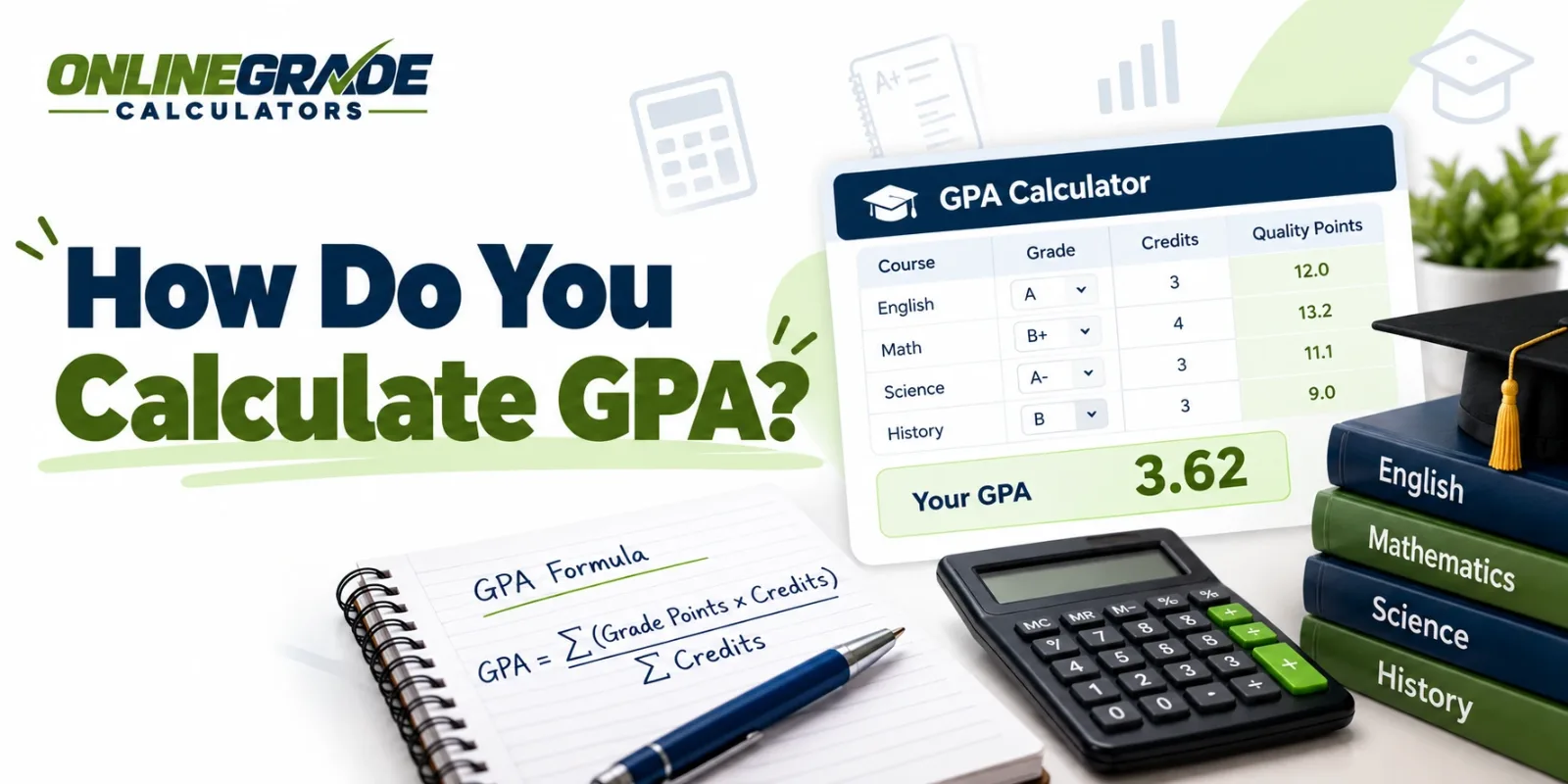
How do you calculate your cumulative GPA if you only have a list of courses and letter grades, not term GPAs? Convert each letter to grade points (A 4.0, A- 3.7, B+ 3.3, B 3.0 and so on), multiply each by its credits, then add every course from every term and divide by all the credits at once. The result is the same as combining term GPAs, as long as you include every course. Our GPA calculator lets you enter several semesters of classes and shows the cumulative result, and the guide on how to calculate GPA explains the grade point step in more detail.
What counts toward a cumulative GPA
- Pass/fail and withdrawn classes usually do not count: no grade points and no GPA credits.
- F grades count as 0 points, with their credits included.
- Repeated courses may replace the earlier grade or be averaged with it, depending on your school.
- Transfer credits often count toward your degree but not toward your GPA at the new school.
- High school weighting may add honors or AP bonuses before the cumulative step. The high school GPA calculator handles both weighted and unweighted versions.
Rules like these are set by each school, so if your number does not match your transcript, check your registrar's or counselor's GPA policy first. The official transcript is the figure that counts for scholarships, honors and applications.
To skip the arithmetic, enter each term's GPA and credits below. You can also add your current cumulative GPA as a single row with its total credits, then add new terms on top.
Is cumulative GPA the same as overall GPA?
Usually, yes. Both terms describe your GPA across every graded term at a school, weighted by credits. Some transcripts also show an institutional GPA, which covers only courses taken at that school, and a combined GPA that includes transfer work. If your transcript lists more than one, check the key or legend to see what each one includes.
Can I just average my semester GPAs?
Only if every semester had exactly the same number of GPA credits. Otherwise, a simple average gives too much weight to small terms and too little to large ones. In the example in this guide, a simple average gave 3.57 while the correct credit-weighted result was 3.41. Multiply by credits first to get an accurate number.
How much can one semester raise my cumulative GPA?
It depends on how many credits you already have. With 34 credits at a 3.41, a 15-credit semester of straight A's would give (116 + 60) ÷ 49 = 3.59. With 90 credits already completed, the same semester would move the GPA much less. Our cumulative GPA calculator can show the best result possible for your next term.
Does a summer class affect my cumulative GPA?
Yes, if it is graded and taken at your school, a summer class adds its quality points and credits like any other term. Because summer terms are usually small, they move the GPA less than a full semester. Summer classes taken elsewhere may transfer as credit only, so check with your registrar before enrolling.