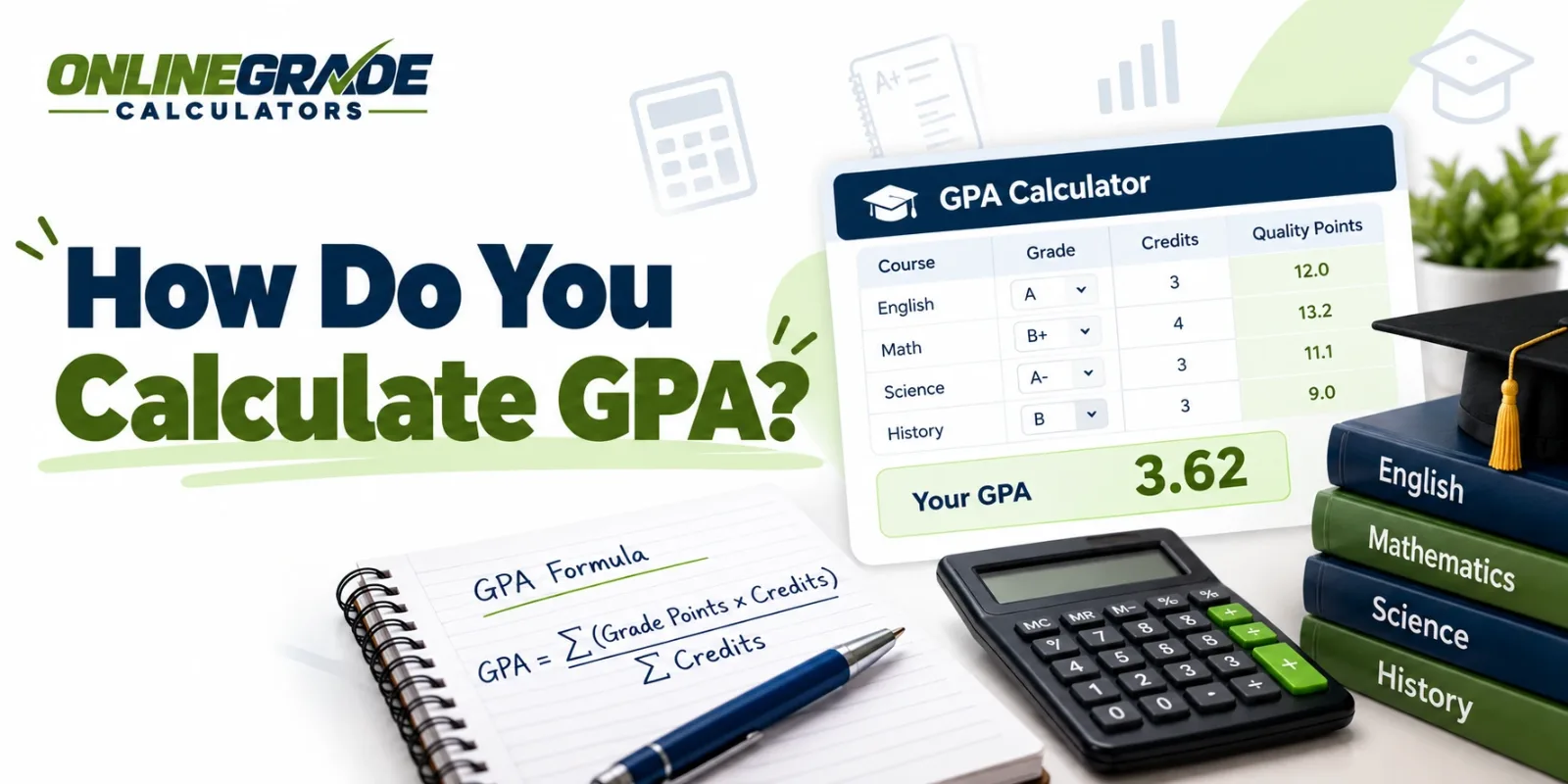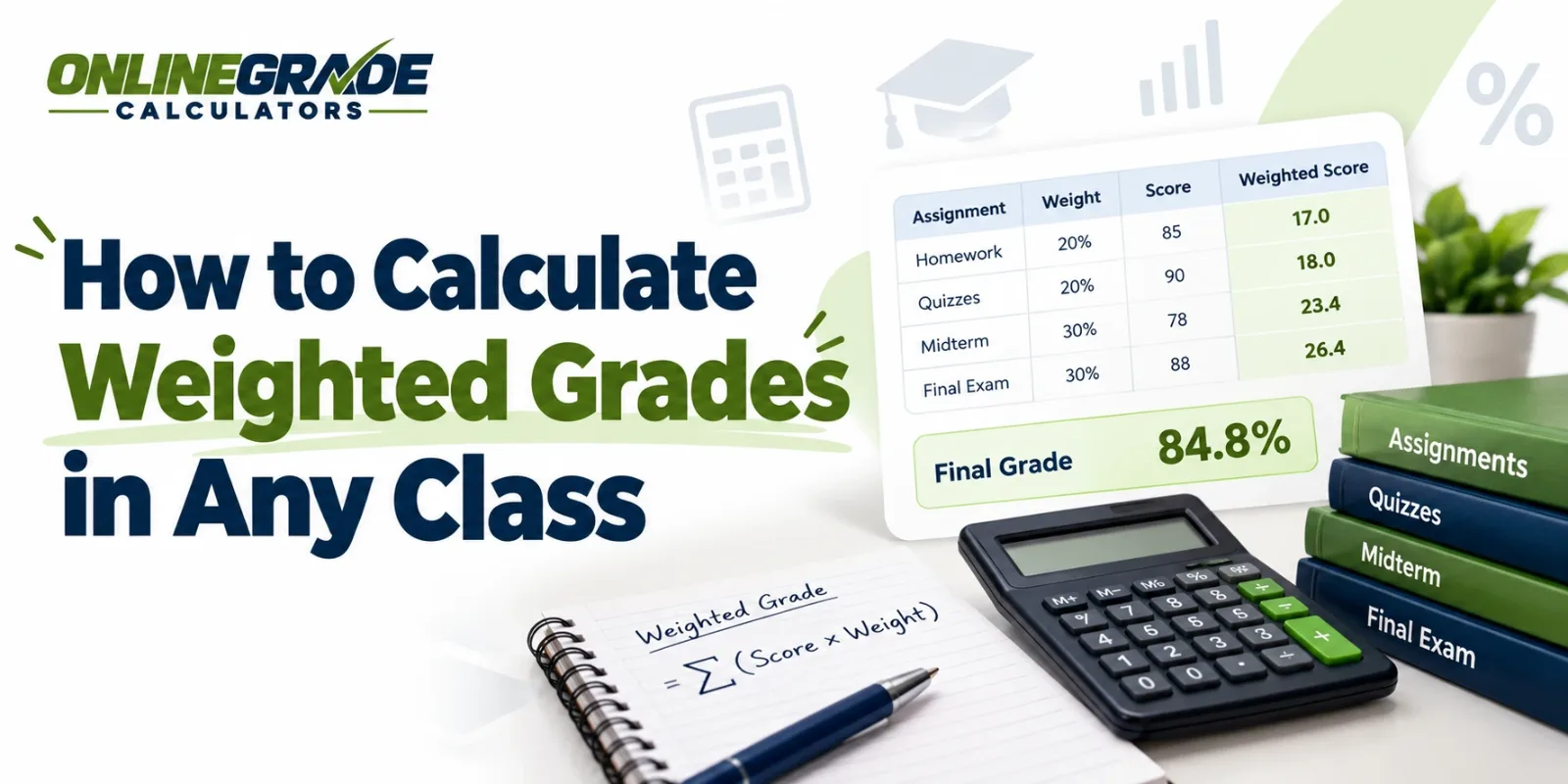

To calculate your high school GPA, first convert each final grade to grade points. On the standard scale, A = 4.0, B = 3.0, C = 2.0, D = 1.0 and F = 0. Multiply each class’s points by its credits, add the results and divide by your total credits. That gives your unweighted GPA. For a weighted GPA, most schools first add 0.5 points for honors classes and 1.0 point for AP, IB or dual enrollment classes.
Your high school GPA (grade point average) is one number that sums up your grades across all your classes. Your school reports it on your transcript, and colleges, scholarship programs and honor societies use it to compare students.
The formula: GPA = total quality points (grade points × credits) ÷ total credits
The 5 steps at a glance:
- Convert each letter grade to grade points.
- Add honors or AP points if you want a weighted GPA.
- Multiply each class’s points by its credits.
- Add up the quality points and the credits.
- Divide the quality points by the credits.
That is the whole method. The rest of this guide shows how to calculate your GPA in high school with a real-looking report card, then covers what changes your number. That includes half-credit classes, A+ grades, your school’s weighting rules, four years of grades and the way colleges recalculate GPA. If you just want the number, the high school GPA calculator shows weighted and unweighted GPA side by side.
What you need before you start
To calculate GPA in high school, you need three things for every class:
- The final grade from your report card or transcript. Use final semester or year grades, not progress report grades, because those can still change.
- The credits for each class. Many high schools give 1 credit for a full-year class and 0.5 credit for a one-semester class. PE, health or electives are sometimes worth less.
- The course level: standard, honors, AP, IB or dual enrollment. You only need this for a weighted GPA.
If your report card shows percentages instead of letters, convert each one to a letter first. For example, 88% is a B+ on a plus/minus scale. A chart of common grading scales shows the usual cutoffs, and pages like 88 percent as a letter grade give the answer for one number.
Step 1: Convert each letter grade to grade points
Most US high schools use the 4.0 scale below. Your school’s handbook has the official version, so check it once, because a few details vary.
| Letter grade | Common percent range | Grade points (unweighted) |
|---|---|---|
| A+ | 97–100 | 4.0 (4.3 at some schools) |
| A | 93–96 | 4.0 |
| A- | 90–92 | 3.7 |
| B+ | 87–89 | 3.3 |
| B | 83–86 | 3.0 |
| B- | 80–82 | 2.7 |
| C+ | 77–79 | 2.3 |
| C | 73–76 | 2.0 |
| C- | 70–72 | 1.7 |
| D+ | 67–69 | 1.3 |
| D | 63–66 | 1.0 |
| D- | 60–62 | 0.7 |
| F | Below 60 | 0.0 |
Three things often differ from school to school:
- A+: most schools count it as 4.0, so an unweighted GPA tops out at 4.0. Some give it 4.3.
- No plus or minus: some schools use only whole letters, so a B+ and a B- are both worth 3.0.
- Percent cutoffs: some schools start an A at 90 and a D at 65. Use your own school’s scale.
Step 2: Add honors and AP weight (weighted GPA only)
A weighted GPA gives extra points for harder classes, so an A in AP Chemistry counts for more than an A in regular chemistry. The most common setup is:
| Course level | Bonus | A becomes | B becomes | C becomes |
|---|---|---|---|---|
| Standard | +0 | 4.0 | 3.0 | 2.0 |
| Honors | +0.5 | 4.5 | 3.5 | 2.5 |
| AP, IB or dual enrollment | +1.0 | 5.0 | 4.0 | 3.0 |
Add the bonus to the points from Step 1. For example, a B+ (3.3) in an AP class becomes 4.3. A failing grade gets no bonus at most schools, so an F stays at 0 even in an AP class. Some schools also give no bonus for a D.
Weighting rules vary more than anything else in this guide. Some schools add a bonus only for AP and IB, some use a 4.5 or 6.0 top scale, and some do not weight at all. If you are unsure, your school counselor or the “grading” page of your student handbook will say. You can set your own bonuses in the high school GPA calculator.
Step 3: Multiply each class’s points by its credits
Many quick guides skip this step. Multiplying by credits gives you quality points, which make a half-credit class count half as much as a full-credit class.
If every class is worth the same number of credits, you can skip this step and simply average the points. If credits differ, which is common, you need it.
Step 4: Add up the quality points and the credits
Add all the quality points together. Separately, add up all the credits you attempted. Include classes you failed, because an F counts as 0 points with its full credits. Leave out pass/fail classes, withdrawals and incomplete (I) grades, since they usually carry no grade points.
Step 5: Divide total quality points by total credits
Divide the first total by the second. Many schools report the result to two decimal places, and some use three. Some round and some cut the number off, so 3.496 could show up as 3.50 or 3.49.
Worked example: one semester, step by step
Here is Maya’s fall semester of 10th grade. Six classes are worth 0.5 credit each, and PE is worth 0.25 credit.
| Class | Level | Grade | Credits | Unweighted points | Weighted points | Unweighted quality points | Weighted quality points |
|---|---|---|---|---|---|---|---|
| English 10 | Honors | A- | 0.5 | 3.7 | 4.2 | 1.85 | 2.10 |
| AP World History | AP | B+ | 0.5 | 3.3 | 4.3 | 1.65 | 2.15 |
| Geometry | Standard | B | 0.5 | 3.0 | 3.0 | 1.50 | 1.50 |
| Biology | Honors | B- | 0.5 | 2.7 | 3.2 | 1.35 | 1.60 |
| Spanish II | Standard | A | 0.5 | 4.0 | 4.0 | 2.00 | 2.00 |
| Digital Art | Standard | A | 0.5 | 4.0 | 4.0 | 2.00 | 2.00 |
| PE | Standard | A | 0.25 | 4.0 | 4.0 | 1.00 | 1.00 |
| Total | 3.25 | 11.35 | 12.35 |
Unweighted GPA: 11.35 ÷ 3.25 = 3.492, which is a 3.49.
Weighted GPA: 12.35 ÷ 3.25 = 3.80. Each honors class added 0.5 points × 0.5 credit = 0.25 quality points, and the AP class added 1.0 × 0.5 = 0.5. That is 1.0 extra quality point in total, which raised her GPA by about 0.31 (1.0 ÷ 3.25).
Common mistake: dividing by the number of classes. If Maya added her seven unweighted grade points (24.7) and divided by 7, she would get 3.53, not 3.49. That method counts her quarter-credit PE class as much as AP World History. Always divide by credits when credits differ.
A semester GPA covers one term, like Maya’s example above. Your cumulative GPA is the one on your transcript and on college applications. It covers every graded class since 9th grade. The method is the same, with more rows: add all quality points from every term, then divide by all credits from every term.
Here is a four-year summary for one student, using unweighted grades. Senior year shows only the first semester, because that is usually what colleges see.
| Year | Credits | Quality points | GPA for that year |
|---|---|---|---|
| 9th grade | 7 | 24.5 | 3.50 |
| 10th grade | 7 | 23.1 | 3.30 |
| 11th grade | 6 | 22.8 | 3.80 |
| 12th grade, fall | 3 | 11.4 | 3.80 |
| Cumulative | 23 | 81.8 | 3.56 |
Cumulative GPA: 81.8 ÷ 23 = 3.56.
If you averaged the four yearly GPAs instead, (3.50 + 3.30 + 3.80 + 3.80) ÷ 4, you would get 3.60. That is too high, because it counts the half year of senior grades as if it were a full year. Never average GPAs directly. Always go back to quality points and credits. The cumulative GPA calculator does this for you if you enter each term’s GPA with its credits.
Through the end of junior year, which is what early applications show, this student’s GPA is 70.4 ÷ 20 = 3.52.
What GPA do you need to reach a goal?
You can turn the same math around. Say this student wants a 3.60 cumulative GPA after the last semester, which adds 3 more credits:
- Total credits will be 23 + 3 = 26.
- A 3.60 needs 3.60 × 26 = 93.6 quality points.
- They already have 81.8, so they need 93.6 − 81.8 = 11.8 more.
- 11.8 ÷ 3 credits = 3.93 for the final semester.
This also shows why GPA gets harder to move each year. The more credits you have banked, the less one semester changes the total. Strong grades in 9th and 10th grade matter a lot for that reason.
Weighted vs. unweighted GPA: which one is “your” GPA?
Usually both. Many high schools print both on the transcript, and each is useful for something different.
| Unweighted GPA | Weighted GPA | |
|---|---|---|
| Scale | 0 to 4.0 (4.3 if A+ counts extra) | 0 to about 5.0 (higher at some schools) |
| Course difficulty | Ignored | Honors and AP add points |
| Best used for | Comparing with college “average GPA” figures and scholarship minimums | Class rank, honors programs and showing a hard schedule |
| Can it go above 4.0? | No, on the standard scale | Yes |
A weighted GPA should always be equal to or higher than the unweighted GPA for the same classes. If yours is lower, you entered a bonus wrong.
Which classes count toward your high school GPA?
This depends on your school, so check the handbook. Common rules are:
- Usually counted: every class with a letter grade, including electives, at most schools.
- Sometimes left out: PE, health, teacher’s aide periods and other non-academic classes. Some schools report a separate core GPA that uses only English, math, science, social studies and world language.
- Usually not counted: pass/fail classes, withdrawals and audits. They have no grade points, so they don’t raise or lower your GPA.
- Middle school classes taken for high school credit, such as Algebra I or Spanish I in 8th grade: some schools put them on the high school transcript and in the GPA, and others list the credit without a grade. For middle school grades in general, use the middle school GPA calculator.
- Retaken classes: some schools replace the old grade, some average the two, and some keep both. Ask before you calculate.
Many colleges don’t take your school’s GPA as is. Schools weight classes so differently that admissions offices often recalculate every applicant’s GPA with one set of rules. Common changes are:
- Using only core academic classes, so PE, art or electives drop out.
- Removing the school’s weighting and applying their own, or none at all.
- Using only certain years, often 10th and 11th grade.
- Ignoring plus and minus grades.
To make this possible, some colleges ask you to list every course and grade yourself. Two common forms are the Common App’s Courses & Grades section and the Self-Reported Academic Record (SRAR).
The University of California is a well-known example. Its GPA works like this:
- It uses only UC-approved “A-G” courses taken from the summer after 9th grade through the summer after 11th grade.
- It ignores plus and minus grades.
- It adds 1 extra point for each semester of a UC-approved honors course, such as AP or IB HL.
- The bonus stops at 8 semesters, and only 4 of them can come from 10th grade.
- A D or F gets no extra point.
The official UC GPA requirement rules list the details, and other colleges publish theirs on their admissions pages.
The practical takeaway is to calculate your GPA your school’s way for your transcript. To compare yourself with a college’s published GPA range, use your unweighted GPA from academic classes. That is closest to how most colleges compare applicants.
Check your answer in 30 seconds
Before you trust the number, run these checks:
- Range check: the unweighted GPA must be between your lowest and highest grade points. Straight A’s and B’s can’t produce a 2.9.
- Ceiling check: an unweighted GPA can’t go above 4.0, unless your school gives an A+ 4.3.
- Weighted check: the weighted GPA must be equal to or higher than the unweighted one.
- Credit check: your total credits should match the “credits attempted” line on your transcript.
- Failed class check: an F must still be in the credit total. Leaving it out makes the GPA too high.
How to calculate GPA for high school from percentages
Some report cards show only a percentage for each class. There are two ways schools handle this.
Most schools convert to a letter first. Turn each percentage into a letter using the school’s scale, then into grade points, then follow the five steps. An 88% is a B+ (3.3) on a plus/minus scale, but a B (3.0) at a school without pluses and minuses. The same report card can produce two different GPAs, which is why the scale matters.
Some schools report a 100-point GPA. They average the percentages, weighted by credits, and report a number like 91.4 instead of a 4.0-scale GPA. If your school does this, you can still convert your average to a letter with your school’s grading scale. Don’t convert an average percentage straight into a 4.0 GPA, though, because averaging percentages and averaging grade points give different answers.
Ways to raise your high school GPA
Once you know how your school builds the number, the levers are clear:
- Protect full-credit classes first. A 1-credit class moves your GPA twice as much as a half-credit one.
- Fix a falling grade early. Dropping from a B to a C costs 1.0 grade point times that class’s credits. A short talk with your teacher in week 4 is easier than a rescue in week 16.
- Take honors or AP where you can earn a B or better. A B in AP (4.0 weighted) matches an A in a standard class on the weighted scale, and colleges also notice the harder schedule. A C in AP (3.0 weighted) only eqCalculate High School GPAuals a B in a standard class, and it counts as just 2.0 in your unweighted GPA.
- Start strong in 9th grade. Early grades become a large share of your cumulative GPA, and later semesters move it less.
- Aim for an upward trend. If your start was rough, rising grades in 10th and 11th grade still help, and admissions readers notice the trend as well as the average.
- Ask about grade replacement if you retake a class. At some schools the new grade replaces the old one completely.
Calculate it in seconds
Doing the math by hand once is the best way to understand your GPA. After that, use the calculator. Enter each class, its grade, its credits and its level, and you get your weighted and unweighted GPA at the same time. You can change the honors and AP bonuses to match your school.
For a college GPA or a GPA without honors or AP weighting, use the GPA calculator. To work out that version by hand, follow the step-by-step GPA formula with examples. To combine several semesters or years, follow the steps for an overall GPA across every semester.