
To calculate your GPA, turn each final grade into grade points (A = 4.0, B = 3.0, C = 2.0, D = 1.0, F = 0), multiply each one by the class’s credit hours, add up the results, and divide by your total credit hours. The answer is your grade point average on a 4.0 scale.
That one sentence covers most report cards and transcripts. Below, you will find a full worked example, plus how to handle percentage grades, pass/fail classes, failed courses and several semesters at once. You will also see why your own number might not match the one your school reports.
The GPA formula
GPA = total quality points ÷ total credit hours
Three terms do all the work:
- Grade points are what a letter grade is worth on the 4.0 scale. A B+ is worth 3.3.
- Credit hours show how much a class counts. Most college classes carry 3 or 4 credits, while many high schools give each class 1 credit (or 0.5 per semester).
- Quality points are grade points multiplied by credit hours for one class. A B+ in a 3-credit class earns 3.3 × 3 = 9.9 quality points.
Colleges use this exact method. The University of Notre Dame registrar’s GPA formulas define a semester GPA as the sum of quality points divided by the credit hours attempted.
How to calculate GPA in 4 steps
- List every class with its final letter grade and its credit hours.
- Convert each letter grade to grade points.
- Multiply grade points by credit hours to get quality points for each class.
- Add all the quality points, add all the credit hours, and divide the first total by the second.
If every class carries the same credit, you can skip the multiplying. Just add the grade points and divide by the number of classes.
Grade point values on the 4.0 scale
Most US high schools and colleges use this plus/minus scale:
| Letter grade | Percentage | Grade points |
|---|---|---|
| A+ | 97–100% | 4.0 |
| A | 93–96% | 4.0 |
| A- | 90–92% | 3.7 |
| B+ | 87–89% | 3.3 |
| B | 83–86% | 3.0 |
| B- | 80–82% | 2.7 |
| C+ | 77–79% | 2.3 |
| C | 73–76% | 2.0 |
| C- | 70–72% | 1.7 |
| D+ | 67–69% | 1.3 |
| D | 63–66% | 1.0 |
| D- | 60–62% | 0.7 |
| F | Below 60% | 0.0 |
Schools differ in small but important ways. Some give an A+ 4.3 points, some drop plus and minus grades entirely, and some move the cutoffs between letters. Your student handbook or registrar’s website lists the official values. To check where any percentage lands, use this grading scale chart with plus and minus cutoffs.
Worked example: calculating a semester GPA
Here is a typical first-year college semester with five classes and 16 credits:
| Class | Grade | Grade points | Credits | Quality points |
|---|---|---|---|---|
| Intro to Psychology | A- | 3.7 | 3 | 11.1 |
| College Algebra | B | 3.0 | 4 | 12.0 |
| English Composition | B+ | 3.3 | 3 | 9.9 |
| Chemistry I with lab | C+ | 2.3 | 4 | 9.2 |
| Art History | A | 4.0 | 2 | 8.0 |
| Total | 16 | 50.2 |
Now run the steps:
- Quality points per class: 3.7 × 3 = 11.1, 3.0 × 4 = 12.0, 3.3 × 3 = 9.9, 2.3 × 4 = 9.2 and 4.0 × 2 = 8.0.
- Total quality points: 11.1 + 12.0 + 9.9 + 9.2 + 8.0 = 50.2.
- Total credits: 3 + 4 + 3 + 4 + 2 = 16.
- GPA: 50.2 ÷ 16 = 3.1375, which rounds to a 3.14 GPA.
Why credit hours change the answer
If you ignore credits and simply average the five grade points, you get (3.7 + 3.0 + 3.3 + 2.3 + 4.0) ÷ 5 = 3.26. That figure is too high. It lets the 2-credit A in Art History count as much as the 4-credit C+ in Chemistry. Credit weighting gives bigger classes a bigger say, and that is exactly how your transcript works.
How to find your GPA from percentage grades
If your grades show up as percentages, convert each class to a letter first, then to grade points. Do this class by class, not once at the end.
Take a high school student with four 1-credit classes:
| Class | Percentage | Letter | Grade points |
|---|---|---|---|
| Biology | 97% | A+ | 4.0 |
| English | 89% | B+ | 3.3 |
| Spanish | 79% | C+ | 2.3 |
| Geometry | 70% | C- | 1.7 |
Since every class carries 1 credit, add the grade points and divide by 4: (4.0 + 3.3 + 2.3 + 1.7) ÷ 4 = 11.3 ÷ 4 = 2.83 GPA.
Averaging the percentages instead gives 83.75%, which looks like a B and a 3.0. That shortcut overstates this student’s GPA, because a GPA counts each class’s letter grade, not a blended percentage. If you still need a class percentage from raw points, the points-to-percentage grade calculator works it out and gives you the letter too.
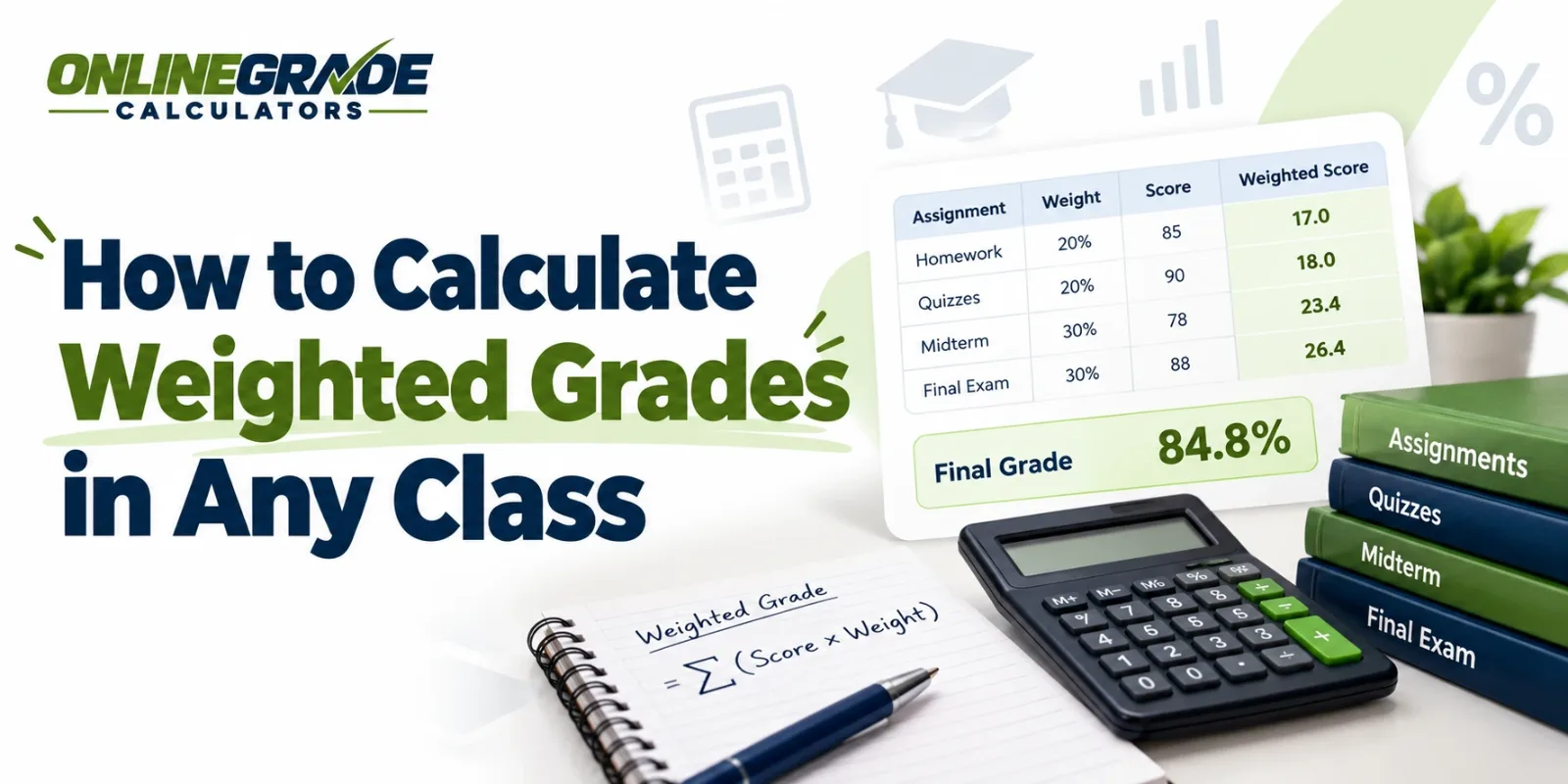
One more caution: “weighted grades” and “weighted GPA” mean different things. Weighted grades combine homework, tests and finals into one class grade, and this walkthrough on how to calculate weighted grades in a class covers that math. A weighted GPA adds bonus points for harder classes, which the section below explains.
Pass/fail, withdrawals and failed classes
Not every mark on a transcript affects your GPA the same way:
- Pass (P) or Satisfactory (S): usually earns credit toward graduation but no grade points. Leave the class out of both totals.
- Withdrawal (W): usually has no effect on GPA. Leave it out of both totals.
- F: counts as 0 grade points, but its credits stay in the total. That is why one F pulls a GPA down so hard.
- Incomplete (I): schools handle it differently, so check your registrar’s rules.
Back to the semester example. If Art History had been taken pass/fail and passed, you would remove its 8.0 quality points and 2 credits: 42.2 ÷ 14 = 3.01. If the student had failed it instead, the quality points drop to 42.2 while the credits stay at 16: 42.2 ÷ 16 = 2.64. One 2-credit class swings this GPA by half a point.
How to calculate cumulative GPA across semesters
Your term GPA covers one semester. Your cumulative GPA covers every graded class you have taken at that school. To find it, add the quality points from all terms and divide by all the credit hours. Do not average the term GPAs.
Say the student above earns a 3.40 GPA over 15 credits next semester. That term adds 3.40 × 15 = 51.0 quality points.
- Total quality points: 50.2 + 51.0 = 101.2
- Total credits: 16 + 15 = 31
- Cumulative GPA: 101.2 ÷ 31 = 3.26
Averaging the two term GPAs, (3.14 + 3.40) ÷ 2, gives 3.27. The gap here is small because both terms have similar credit loads. It grows when one term is much lighter than another, such as a 6-credit summer session. For longer histories, the cumulative GPA calculator adds up every term for you, and this step-by-step cumulative GPA walkthrough covers more examples.
Weighted vs. unweighted GPA
Everything above produces an unweighted GPA, where an A is worth 4.0 in every class. Many high schools also report a weighted GPA, which adds bonus points for honors, AP, IB or dual-enrollment classes. A common setup adds 0.5 for honors and 1.0 for AP or IB, so a B in AP Biology counts as 4.0 instead of 3.0. Policies vary by school and district, though, so the bonus in your school may differ.
The math stays the same once you add the bonus: weighted grade points × credits, then divide by total credits. For honors and AP weighting, four-year totals and what colleges look at, read this breakdown of how high school GPA works with honors and AP classes, or enter your classes into the weighted and unweighted high school GPA calculator.
Why your GPA may not match your school’s
If your number comes out a little different from the one on your portal or transcript, one of these is usually the reason:
- Rounding vs. truncating. The example semester above works out to 3.1375. Rounded, that is 3.14. Some schools cut off extra digits instead. The University of Illinois registrar’s GPA rules state that its GPA is truncated, not rounded, so the same semester would show as 3.13 there.
- A different A+ value. A school that gives an A+ 4.3 points will report a higher GPA than the standard 4.0 scale.
- Repeated classes. Many colleges replace the old grade when you retake a class, while others average both attempts or count both.
- Transfer credits. These often count toward your degree but not toward your GPA at the new school.
- Midterm grades. GPA uses final grades. Progress grades on a portal can change before the term ends.
Treat your school’s official transcript as the final word, and use your own calculation to check it.
A quick sanity check helps too: your GPA can never be higher than your best grade point or lower than your worst. In the example semester, the highest grade point is 4.0 and the lowest is 2.3, so a result of 3.14 makes sense.
How to find the GPA you need next semester
Once you know your current totals, you can work backward to a goal. Using the first semester (50.2 quality points over 16 credits), say you want a 3.30 cumulative GPA after another 15 credits:
- Quality points the goal needs: 3.30 × 31 credits = 102.3
- Quality points you still need: 102.3 − 50.2 = 52.1
- GPA needed next term: 52.1 ÷ 15 = 3.47
A 3.47 term GPA sits between a B+ and an A-. If the result ever comes out above 4.0, the goal is out of reach in one term on an unweighted scale. Spread it over two terms or take more credits.
Keep a running record of your quality points and credits each term. It turns every future GPA question into a two-minute calculation, and it helps you spot a mistake on your grade portal before it causes trouble.